After Having His Motel Seized by the Government, Victim of Civil Asset Forfeiture Reflects on His Fight
Russ Caswell, owner of Motel Caswell in Tewksbury, Mass., fought the law and won. Now, he’s reflecting on his experiences with a law enforcement tool known as civil asset forfeiture as policymakers in Washington, D.C., and across states from coast to coast, debate the practice.
“The government tried to take [Motel Caswell] based on just a handful of drug activity cases that they had that I didn’t even know had existed,” Caswell told The Daily Signal.
Caswell’s father built Motel Caswell in 1955, and in the 1980s, he and his wife, Patricia, took over managing the business. The motel, which they owned mortgage-free, was supposed to provide the Caswell’s with their retirement.
However, several years ago, the Drug Enforcement Agency and Tewksbury Police Department seized the property because guests at the motel had been arrested for drug crimes.
Caswell was unaware of the illegal activity, which took place behind locked doors, but he had always cooperated with law enforcement in the past.
The state and federal agencies argued that because there had been drug arrests on 30 different occasions, the property was theirs for the taking. The Caswells, though, had rented rooms in the motel more than 125,000 times over a period of 17 years.
Though the federal government and local police department contended they had seized the property because of the crimes committed there, Caswell believes they wanted to sell Motel Caswell for a profit.
And when Caswell filed a lawsuit challenging the seizure, a DEA agent confirmed his suspicions.
During depositions, Special Agent Vincent Kelly told lawyers that he was tasked with finding properties to be forfeited. Often times, he said, the agency wouldn’t go after a property unless an owner had more than $50,000 worth of equity.
Motel Caswell was worth $2 million.
>>> How California Cities Are Making Millions Seizing Property and Money From Law-Abiding Citizens
“That’s what they were after,” Caswell said. “This had nothing to do with drugs. It was just an excuse to steal property from us.”
With the help of lawyers from the nonprofit Institute for Justice, which represented him pro bono, Caswell was successful in getting his motel back. However, the government did try to convince him into settling, which Caswell called “nothing more than an extortion plot.”
“They had nothing to get us on because we did nothing,” he said of law enforcement.
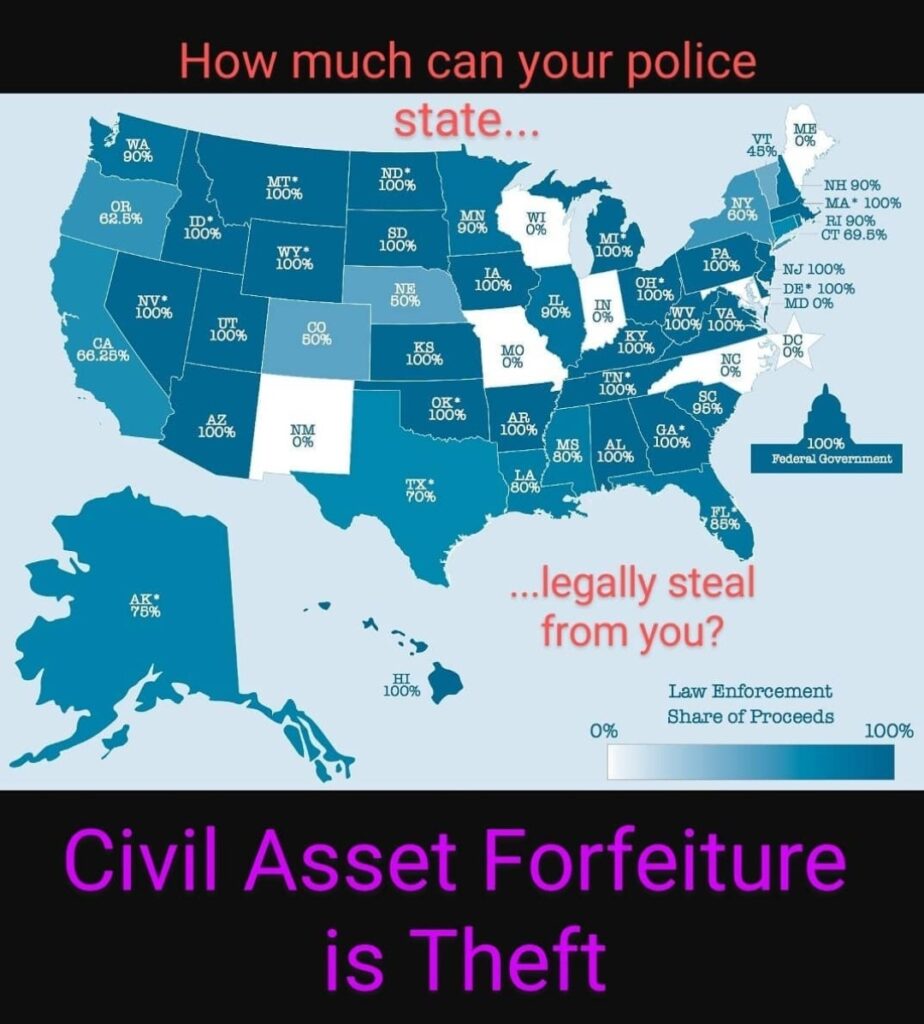
Civil asset forfeiture is a tool that gives law enforcement the power to seize property if it’s suspected of being related to a crime. The practice began decades ago with the intention of curbing money laundering and drug trafficking, but law enforcement officials have been using civil asset forfeiture to seize property and money for profit.
In fact, law enforcement agencies have made more than 55,000 seizures of cash and property worth $3 billion since 2008 through a program known as Equitable Sharing, which allows local law enforcement agencies to share in the proceeds from seizures.
Often times, people who have their property seized have no idea they committed a crime, like Caswell. The practice, according to policy experts calling for reforms, turns the principle of “innocent until proven guilty” on its head.
Advocates of civil asset forfeiture reform believe the practice hurts innocent property owners refuting their forfeitures. Additionally, many argue the tool creates perverse incentives for law enforcement, as the proceeds from seized cash and property often benefit police department and prosecutors’ offices.
Caswell was ultimately successful in fighting federal and local law enforcement for his property, but many victims choose to settle rather than undergo years of litigation and surrender portions of their cash and property. Still, he has a hard time reconciling why it was the presence of drugs in Motel Caswell that caused law enforcement to act.
“If you think about it a little bit, they let the drugs come into town—probably coming in from Mexico at lot of it. It comes all the way across the country through a whole bunch of states. Nobody catches it. It gets into Massachusetts and nobody catches it. Then it gets onto my property and all of a sudden it’s my fault,” Caswell said. “And they want to steal my property and reward themselves for their own failure. They’re the ones who should be keeping drugs out of Massachusetts and the country, not some motel owner. That’s up to them.”
You might also like:
Civil Asset Forfeiture: Where Due Process Goes to Die | Creating Redundant Power and Network Infrastructure in Modern Data Centers | Civil asset forfeiture creates perverse incentives that can cost you your property. | Civil Asset Forfeiture Corruption | Michigan Man Cleared of Wrongdoing, Still Fighting Civil Forfeiture Years Later | Precision Cooling for High-Density Racks: Compliance and Warranty Issues | Deputy AG Rosenstein on Civil Forfeiture, Mandatory Minimums | Forfeiture Funds Fancy Food for Officials | Police Stole My Life Savings! Civil Asset Forfeiture | Class Action Against FBI For Abusive Seizure and CIVIL FORFEITURE! Viva & Barnes HIGHLIGHT! | Federal Equitable Sharing – Asset Forfeiture Program | Ensuring Compliance: A Guide to Key Data Center Standards and Regulations | Police agencies forfeit millions after new law chokes off funds from asset seizures | Carbon-Neutral Data Centers: Contracting Renewable Energy and Tracking Emissions | Bennis v. Michigan, Supreme Court OKs Civil Forfeiture | Leveraging Insurance Options for Data Center Liability Coverage | Federal Loophole Thwarts State Curbs on Police Seizures of Property | Pima County Sheriff – Talking With Civil Asset Forfeiture Recipient | Protecting Your Business: Legal Strategies | JUSTICE MANUAL 9-119.000 – Asset Forfeiture Approval, Consultation, And Notification Requirements | Data Centers and the Law: A Comprehensive Overview | The Supreme Court Has Limited How Much Private Property States Can Seize | Key Legal Considerations in Data Center Service Agreements | Operational Compliance for Data Centers: Ensuring Legal & Regulatory Adherence
Additional Reading:
Maine Now Requires Criminal Conviction Before Property May Be Forfeited | The Bronx Defenders – Civil Forfeiture | Asset Forfeiture Defense Strategies for Farms & Land | Alabama Shows How Law Enforcement Can Get Behind Asset Forfeiture Reform | Property Seizure Rights – Rucci Law | John Oliver Civil Asset Forfeiture Clip | Avoid seizures of cash by taking prudent measures | Reforming Civil Asset Forfeiture (ACLU) | Great News: New Mexico’s Asset Forfeiture Reform Bill Signed by Governor | Both parties in New Mexico and elsewhere see bad problems in good-intentioned civil forfeiture laws | Civil Asset Forfeiture “Has Created Serious Problems” | How States Are Using the Courts to Fight Police Taking People’s Money and Property | Judge finds no rights violations in FBI seizure of Beverly Hills safe-deposit boxes | How the Feds Are Using Civil Asset Forfeiture to Threaten Free Speech | Sixth Circuit Announces Criminal Forfeiture Under Fed. R. Crim. P. 32.2(b) Is Mandatory Claims-Processing Rule, Reverses $62.5 Million Money Judgments | Senate Seeks New Standard in Asset Forfeiture Cases | This Federal Program Lets Cops Seize Cash, Evade State Laws And Keep Over A Billion Dollars | Professional Vehicle Forfeiture Defense Legal Services | Asset Forfeiture Injustice – Rucci Law | Wisconsin Enacts Sweeping Civil Asset Forfeiture Reform | Report: Government Seizes Billions in Private Property, but Citizens Have Little Recourse | FBI Asset Recovery Legal Strategies | Indiana Supreme Court Applies Eighth Amendment to Curb “Oppressive” Asset Forfeitures | Robert Durst to Cops: I Want the $161,000 You Seized